Common Mistakes When Writing Your First Short Story (and How to Fix Them)
The first short story is almost never good, and that is exactly as it should be. What separates writers who improve quickly from those who stay stuck is knowing which mistakes are doing the damage. Most first drafts fail for a handful of predictable reasons: the story warms up instead of starting, the cast is too large, the ending explains itself. None of these problems is fatal, and each one has a fix you can apply this afternoon with the draft open in front of you.
Openings That Warm Up Instead of Start
Read your first paragraph and ask two blunt questions. Has anything changed? Would a reader be surprised if the story stopped there? Many drafts open with a character waking up, driving somewhere, or thinking about the day ahead. It feels like a safe way in, but it is really the engine idling on the driveway.
Find the first moment where something is genuinely at stake and begin there. Whatever set-up you need can be folded into that scene: a name in a text message, a photograph on the mantelpiece, a line of dialogue.
Compare these two openings. Emma woke late, made coffee and thought about the meeting she was dreading. Now: Emma was still in her dressing gown when the doorbell rang, and she knew before she opened it that the keys had arrived. The second version has a body in a room, a delay and a small piece of dread. Something is already happening.
If you are still unsure, cut the first three paragraphs and read from there. More often than not, the story has quietly started without you.
Too Many People, Too Many Threads
A short story is not a compressed novel. It runs on one character, one situation and one turn. First drafts routinely arrive with seven named characters, a subplot about a failing business and a flashback to a childhood holiday, none of which the ending needs.
Apply a cast list test. Mark every character who appears more than once. If someone exists only to deliver information — the doctor, the colleague who mentions the affair, the neighbour with the rumour — ask whether your main character could learn it another way, or whether that character could be merged with one who already exists. Fewer people, deeper relationships.
- Cut any subplot introduced after the halfway point. It cannot pay off.
- Merge minor characters who do similar jobs: two sisters become one.
- Move backstory into the present tense of the story, or leave it out.
- Keep the setting simple. One house, one afternoon, is plenty.
Telling Us About the Story Instead of Showing It
There is nothing wrong with summary. A sentence that skips three uneventful weeks is a gift. The problem is summary where a scene belongs: the argument reported rather than heard, the funeral flattened into adjectives, the decision announced instead of made.
Test each passage by asking whether the reader should be inside it or outside it. Big emotional turns need scenes — dialogue, physical detail, a moment that takes time. Everything else can be summarised in a line.
Compare James was angry with his brother with James kept his eyes on the cereal bowl and tapped his spoon against the rim until his brother stopped talking. The first tells us the fact. The second lets us watch it and decide for ourselves what it means.
Characters Who Want Nothing in Particular
A story needs someone who wants something specific, soon, and cannot easily have it. Vague longing — to be happy, to feel whole, to move on — gives the reader nothing to lean on, because nothing specific can be won or lost.
Give your main character a concrete want with a deadline. She wants the flat signed over before Friday. He wants the letter read aloud at the funeral. Then add the obstacle that will not move, and work out what it costs them to keep trying. That cost is the story.
Dialogue That Explains Rather Than Reveals
First drafts contain a great deal of dialogue that repeats the plot. Characters remind each other of things they both already know, state their feelings plainly, and say goodbye at the end of phone calls. It sounds reasonable and reads as flat.
Cut the first two lines of every exchange and see if it still works. Most conversations survive, and often improve, because the reader joins a beat late and has to pay attention. Then look for on-the-nose lines — I'm furious with you, You've never understood me — and replace them with what a person would actually say or do instead: change the subject, wash up, ask about the weather.
Read dialogue aloud. If you run out of breath or stumble over a sentence, your reader will too.
Endings That Explain Themselves, or Just Stop
Two endings turn up in almost every first draft. The first states the moral outright: the character learns a lesson, thinks it through and tells us what it meant. The second simply stops, leaving threads loose and hoping ambiguity will be read as art.
Ambiguity is powerful when the facts are clear and the meaning is open, and frustrating when the reader cannot tell what happened. Aim for the first kind. Settle the practical questions — where she is now, what she has decided — and let the emotional one echo.
Write three endings if you have the patience: one where the character gets what they wanted, one where they do not, and one where they get something else entirely. The third is often the story you were trying to write. The best final lines tend to be an action, an image or a piece of dialogue, never a summary of the point.
A Revision Plan That Takes a Week, Not a Year
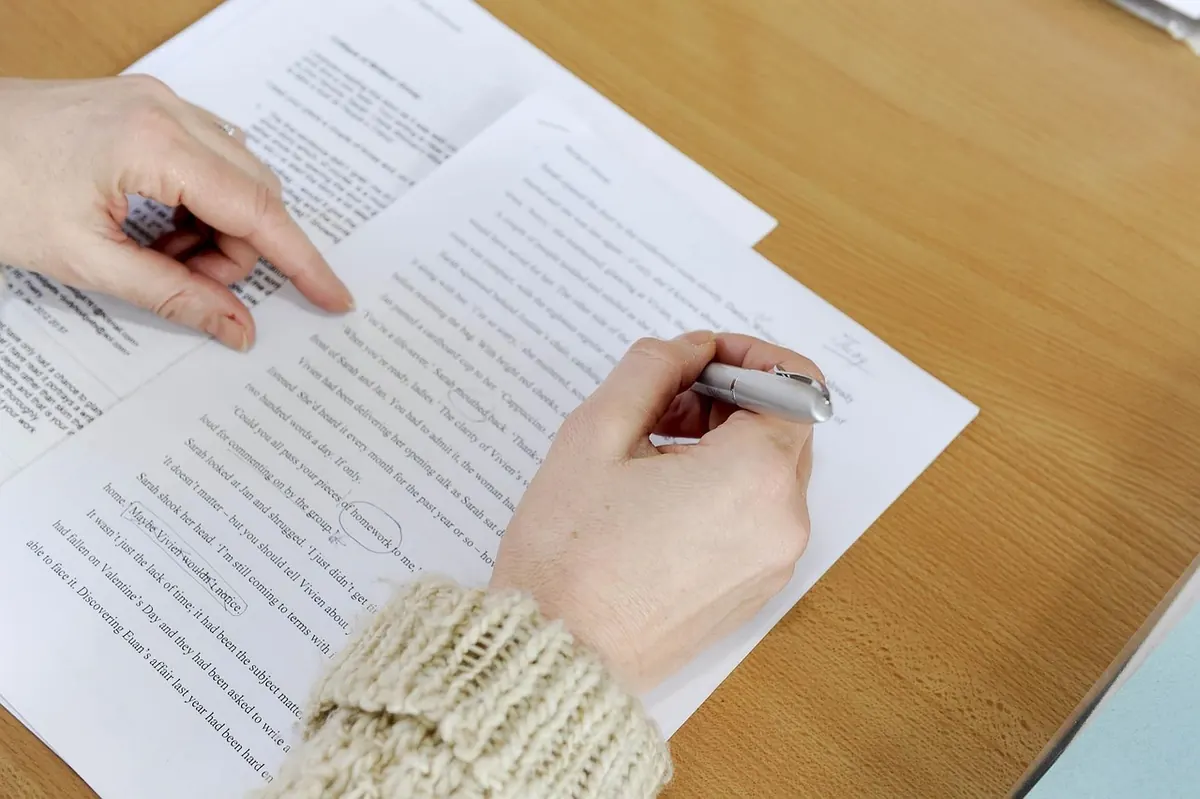
Put the draft away for a day, then work through it in passes. Doing one job at a time stops you tidying commas while the story's spine is broken.
- Read for shape only. Mark the point where you first got bored; that is usually where the story should have started.
- Check the opening and the close. Have a first line that grips and a last line that lands. The middle can be repaired around them.
- Trim roughly a tenth. Cut adverbs, repeated gestures and any sentence that repeats what the previous one showed.
- Check consistency. Keep tense and point of view steady. If you begin with "I", stay with "I".
- Read it aloud. Where your voice snags, your reader's eye will snag too.
Then send it somewhere. A finished, imperfect story teaches you more than a flawless paragraph you have rewritten twenty times. Start the next one, and you will bring better instincts to it.
Photo: Pixabay / Pexels